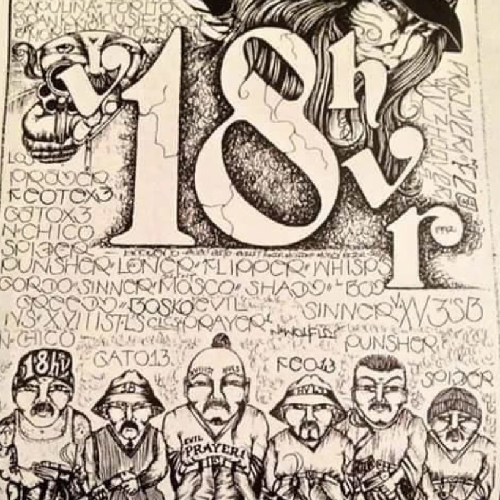


S/S BARRIO EIGHTEEN ST
Background: Barrio 18th Street also known as 18ST or BEST in Los Angeles the 18th Street gang is considered the largest gang in Los Angeles County The 18th Street gang formed around 1965 in the Pico Union area when members of larger Westside Clanton 14th Street neighborhood decided to start a new click. Originally, 18th Street was a click of the bigger Clanton 14th Street neighborhood (First Hood) who had another neighborhood, Eastside Clanton that was split by the freeway construction of the early 1950s.
As membership of Clanton grew, newer members who lived off of 18th Street and Arapaho Street decided to start Clanton 18th Street. Forming a new click of a gang can sometimes be a challenge, because some members may look at it as an action that does not unify but separates the neighborhood, and possibly creates division between members that will be forced to choose sides during a conflict. On the other hand, adding a click can expand the turf, bring in more members, and make the neighborhood appear to be stronger.
There is usually a protocol to creating a new click and each neighborhood is different when it comes to that, but ultimately Clanton 14 core members did not approve of having Clanton 18. One of the reasons why original Clanton members began to reject the 18th Street click, was because it was being led by a non Mexican-American, named Rocky Lee Glover (b. 1950 – ).
The new click members had to make a decision between falling in line with Clanton 14 and the strict rule of Mexican-Americans only, or take a defiant position to start their own gang and create Barrio 18th Street.
Some decided to stay with the more established Clanton identity, but Rocky Glover and a dozen other teens decided to just simply dropped the Clanton off their name and then became rivals against them. As the years progressed, Clanton lost most of their first westside hood in the Pico-Union area, and today that area is completely dominated by 18th Street and a few other gangs. Other early 18th Street members during the 1960s included Beto, Eddie Boy, Goofy, Indio, Penguin, Tank, Toro and Smiley who were initially Clanton members of the 1st hood that all decided to take their click into another direction.
Clanton did not disappear though as their neighborhood in Hollywood off Beverly has survived and their other Eastside neighborhood still exists in two areas. Most gangs today have clicks and there is usually little resistance from the rest of the gang when members want to start a new click, because there is a perceived benefit to the entire gang as outsiders will assume the gang is growing, and it provides a psychological edge against their rivals.
Through a small act of defiance, one of the most well known gangs was born in Los Angeles. Because of its aggressive recruiting techniques of accepting members even if they were not Mexican-American, there are approximately 200 separate individual autonomous gangs operating under the same name within separate barrios in the San Fernando Valley, the San Gabriel Valley, the South Bay, Riverside California, East Los Angeles, South Los Angeles, Downtown Los Angeles, Mid City, Pico Union, Inglewood, Cudahy, Lynwood, South Gate, Huntington Park, Maywood and Orange County. the name of this gang has caught on and has been copied and mimicked in several other cities and countries around the world. Contrary to popular belief, not all of the 18th Street neighborhoods operate in unison, know each other, or even get along.

War against Bloods: certain factions of 18th Street in South Los Angeles are feuding with Black gangs, specifically the Bloods. In 1994, members of the Rancho Park click that were hanging out on Gibraltar Avenue in the Jungles got into a conflict with members of the Black P Stones in the Jungles. The actual source of this conflict remains in question, but an argument ensued, and an 18th Street member was murdered, thus starting the cycle of violence between the Bloods and the 18th Street. The Black Stones from the City joined the conflict, then in 1996 the Rollin’ 20s Bloods got involved. More recently the Fruit Town Brims, the 4th Blood gang joined the conflict against the 18th Street. This conflict followed the war between the Venice Shoreline Crips, a predominately black gang and the Hispanic Venice 13, that saw 17 murders in 9 months from 1993-94. Eventually, Venice 13 had the support of three other Hispanic gangs; Culver City Boys, Sotel, and Santa Monica 13, but that war was over by 1996.

Insignia: 18th Street gang members often identify themselves with the number 18 on their clothing and sporting clothing from sports teams such as the Los Angeles Dodgers, Los Angeles Lakers and Oakland Raiders. 18th Street will use the symbols XV3, XVIII, 666, 99,(9+9=18), and 3-dots in their graffiti and tattoos. 18th Street colors are blue and black; blue is to represent Sureños, the gangs from the oldest barrios in Southern California, and black is to represent the original color for the gang.